
Temporary Water Relief in Jeju Golf: Check Where Rule 16 Lets You Drop Without Penalty
An illustration generated to help explain the text — not a photograph.
On the day after rain, there may be water standing on one side of the fairway, and your ball may stop right in it. Whether you can take relief without penalty, and where to drop, is set out in R&A Rule 16. Without assuming the Local Rules of any particular Jeju golf course, here is the relief procedure Rule 16 sets out for a ball in the general area.
The abnormal course conditions Rule 16 covers
R&A Rule 16 covers the free relief allowed from interference by animal holes, ground under repair, immovable obstructions and temporary water. The Rules call these four abnormal course conditions. A puddle left on the fairway after the rain stops is a typical example, and ground under repair marked as such is handled under the same Rule.
The biggest difference from penalty area relief or unplayable ball relief is that there is no penalty. If the conditions are met you can move the ball without losing a single stroke, so it matters to know exactly when interference is considered to exist.
The two cases in which interference exists
Under Rule 16.1a, interference exists in two cases. One is when the player's ball touches or is in or on an abnormal course condition. The other is when an abnormal course condition physically interferes with the player's area of intended stance or area of intended swing. Even if the ball is on dry grass, interference exists if your feet would be in the puddle when you take your stance.
There is an exception, however. Relief is not allowed when interference exists only because the player chooses a club, type of stance or swing, or direction of play that is clearly unreasonable under the circumstances. Deliberately standing facing the puddle to create relief is not accepted.
The nearest point of complete relief and one club-length
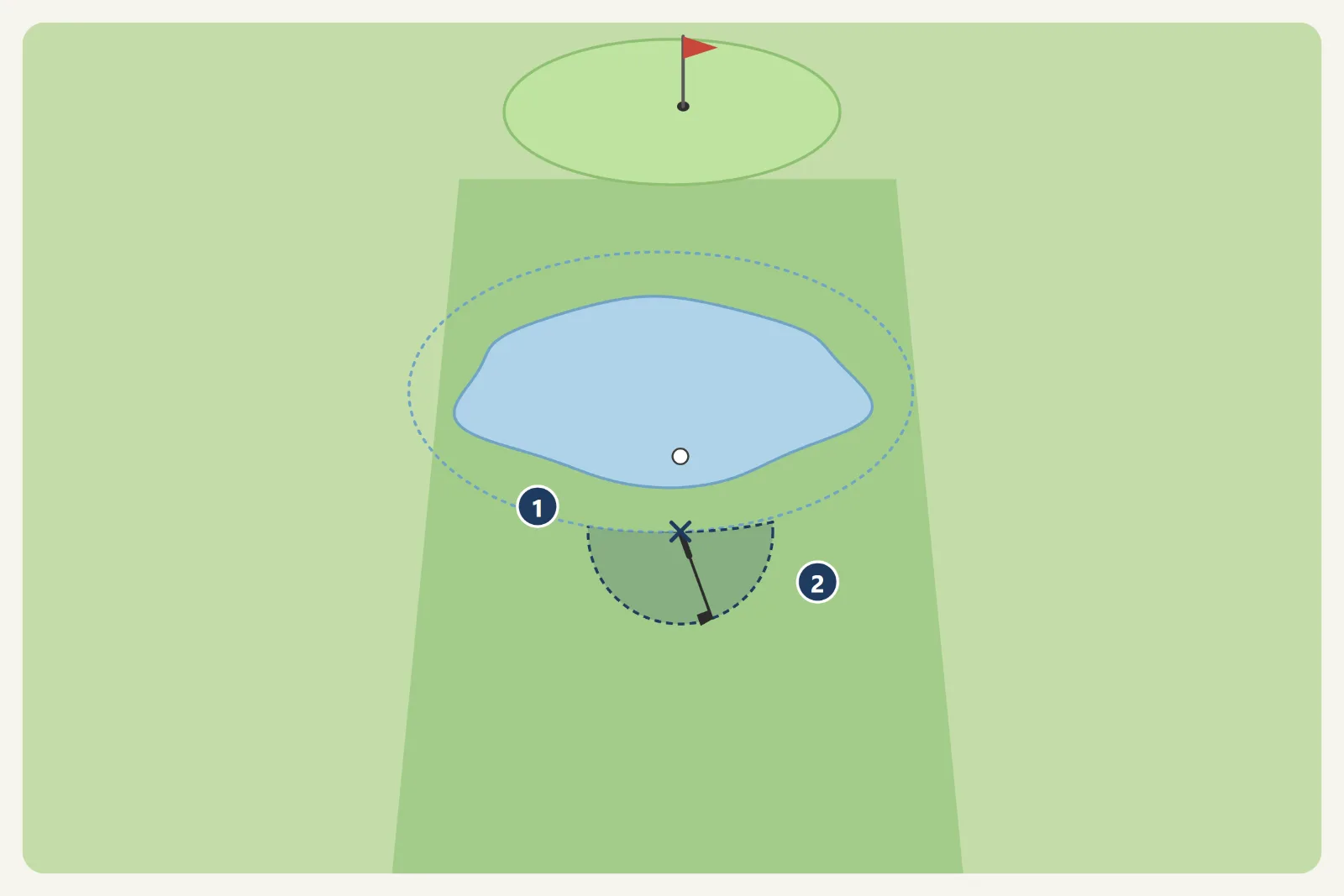
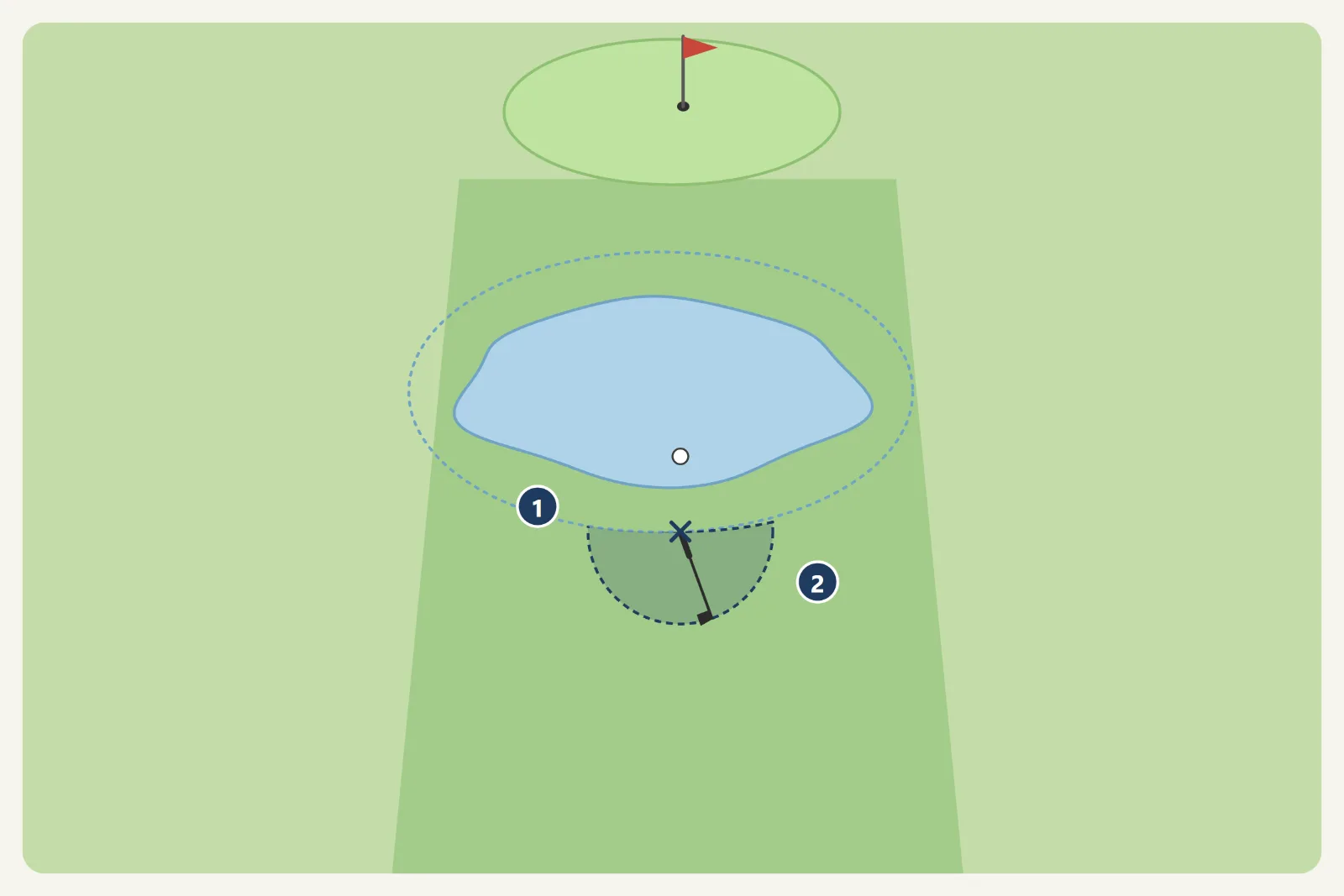
If the ball is in the general area, relief is taken under Rule 16.1b. The reference point is the nearest point of complete relief in the general area, and the size of the relief area is within one club-length of that reference point. The player may take free relief by dropping the original ball or another ball in a relief area that meets all of the requirements.
The relief area comes with three requirements. It must be in the general area, it must not be nearer the hole than the reference point, and it must be an area where there is complete relief from all interference by the abnormal course condition. A spot where any interference remains, such as standing over the edge of the puddle, cannot be the relief area.
The reference point here is not a convenient spot the player picks; it is the point closest to the original ball among the points where the interference disappears completely. There is no guarantee that point is on fairway grass, so fix the reference point first and then choose where to drop within one club-length, and the order will stay clear.
Get on the same page with your group before you tee off
Before heading out for a round after rain, make a short list of what to check.
- Does the ball touch or lie in the water, or does the water interfere with your stance or swing? Either one means interference exists
- Does the interference exist only because of a deliberately unreasonable stance or direction? If so, there is no relief
- The reference point is the nearest point of complete relief in the general area
- Drop within one club-length of the reference point, in the general area, not nearer the hole and completely clear of the interference
Confirm the reference point together with your fellow players before you drop, so the standards do not diverge later. This article is based on R&A Rule 16; for cases it does not cover, such as relief in a bunker or on the putting green, check the text of the Rule separately. It does not assume the Local Rules or course conditions of any particular Jeju golf course, so also check the information for the round you are playing in.
Who this is for
- Golfers who want to go over the Rules again before a Jeju round after rain
- Travelers who want to agree in advance on free relief standards in club rounds
Sources
- 골프 규칙 16 비정상적인 코스상태 · R&A
Last updated